How small is smaller? Is it just the hot weather? Is it the shade?
*Beads of sweat appear on your forehead*
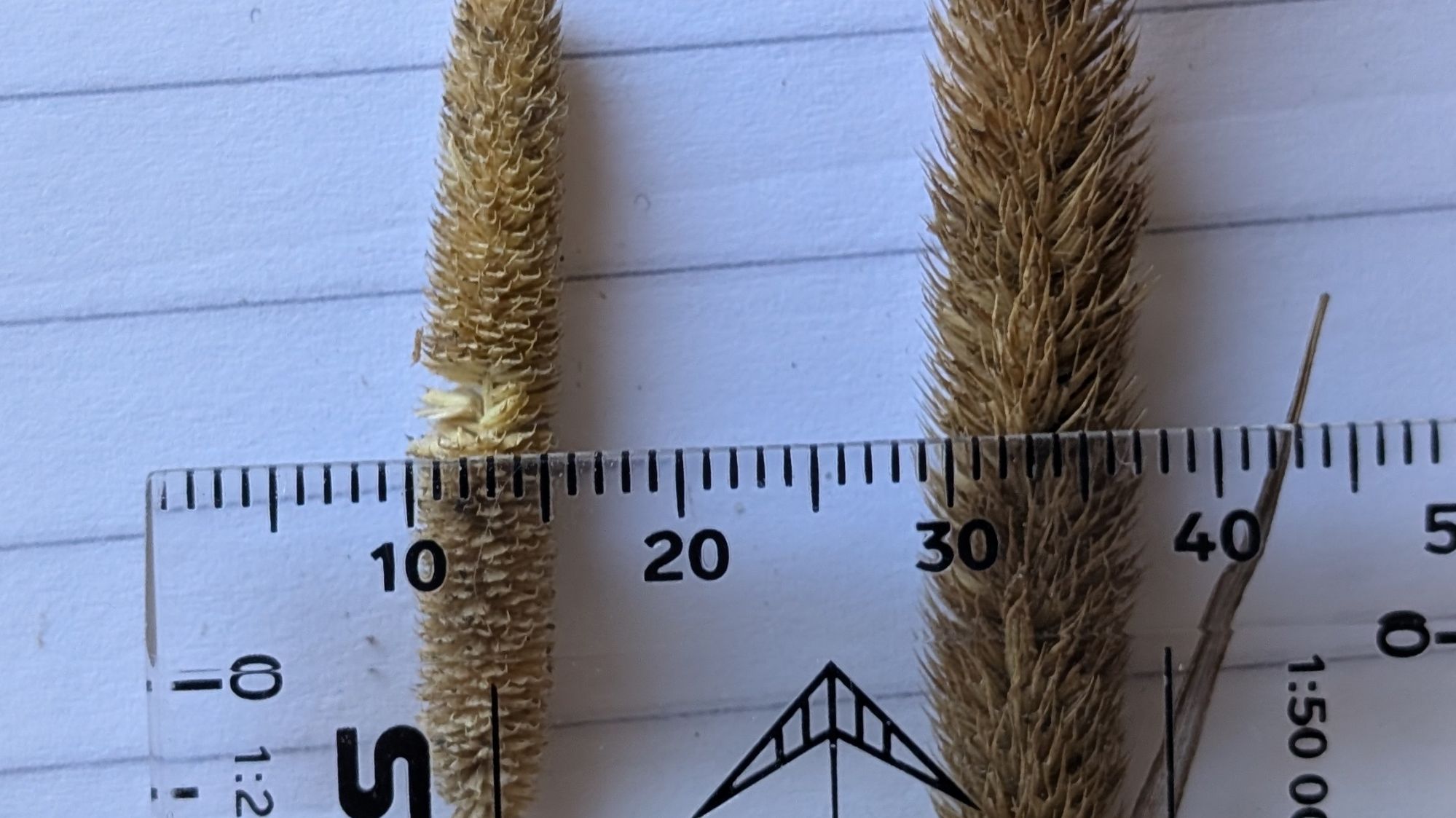
During our Worcestershire Flora Group meeting at Alfrick, I collected a suspected smaller cat’s-tail Phleum bertolonii to measure back at home, tea in hand. Attendee Sam Groves kindly curated some typical Timothy Phleum pratense, so I took both back for comparison. As we suspected, we had both species.
This was a fun learning experience, so I’ll leave it here for future use, for a sweaty-browed botanist somewhere…
Comparison of Phleum bertolonii and Phleum pratense


In principal, P. bertolonii is smaller in all parts and stature (10-50cm) than P. pratense. It’s important to sample and measure many of the floral parts to make a true determination.
In the simplest terms, if a plant is short, has spikelets (including awns) less than 3.6mm long, panicles 3-6mm wide and leaves 2-6mm wide, you have P. bertolonii. Below, I’ve provided the differences as listed by Stace, the measurements of our specimens and photo comparisons. Enjoy!
| P. bertolonii | P. pratense | |
| 1. Spikelet and awn lengths | 2-3.6 (3.8)mm including awns 0.2-1 (1.2)mm | (3.5)4-5.5mm including awns (0.8) 1-2mm |
| 2. Panicle width | 3-6 (6.7) mm | 5-10mm |
| 3. Leaf width | 2-6mm | 3-9mm |
| 4. Ligule shape (usually) | Acute | Obtuse |
Our specimens of P. bertolonii had:
- Spikelets around 2-2.5mm, with a short awn around 0.5mm.
- Panicle width of ~ 5mm
- Leaf width of 2mm
By comparison, our specimen of P. pratense had:
- Spikelets ~ 5mm, with a longer awn around 1.5-2mm
- Panicle width of ~8mm
- Leaf width of 6mm
Comparison Photos
Spikelet and awns
Panicle width

Leaf width
All of which fit well within the specifications given in Stace.
Leave a Reply