Category: Recording

Detailed posts about biological recording.

  • 79 Lane-side Plants to Look for this Spring (Hopehouse Lane, 2025)

    79 Lane-side Plants to Look for this Spring (Hopehouse Lane, 2025)

    1. Introduction
    2. The Route
    3. Observations
    4. List of Flowers by Month
      1. March
      2. April
      3. May onwards

    Introduction

    They reckon your brain works better after a walk in nature, and I agree. Every day I spend at the office, I go on a short walk. Hopehouse Farm to St. Peter’s Church via Hopehouse Lane.

    This blog explores the botanical delights encountered during that walk, proving that all you need is one short walk a day to appreciate your local flora. 

    At the end of the blog, there is a list of all the species encountered, organised by month. Why not try ticking some off this spring?

    The Route

    Observations

    Whilst lanes might seem unremarkable in comparison with a species-rich grassland or upland flush, it’s often in the waysides, the remnants of countryside, that many of our native plants can be found. Here, they are poised and waiting for their moment to return to the wider landscape.

    Greater stitchwort, Hopehouse Lane. 09.04.25

    Along Hopehouse Lane, the bases of the hawthorn hedgerows are scattered with plants typically associated with ancient woodland, such as Greater Stitchwort Stellaria holostea and Dog’s Mercury Mercurialis perennis. These hedgerows represent a small snapshot of the woodlands that once would have been widespread in the area before being cleared in times gone by, or as Wordsworth put it…

    “These hedgerows, hardly hedgerows, little lines of sportive wood run wild”

    Dog’s mercury, Hopehouse Lane. 12.03.25.

    A particularly interesting find, which was only yards from the office, was Dwarf Elder Sambucus ebulus (below). This locally scarce species is an archeophyte, and is thought to have naturalised in Britain between the Neolithic period and 1500 AD.

    Dwarf elder Sambucus ebulus on Hopehouse Lane. 29.04.25

    Between the lane and the hedgerow is rough grassland. This linear belt, sandwiched between the tarmac and the hedgerow, is the last stand for a suite of grassland and woodland edge species. Here, species such as Common Century Centaurium erythraea, Primrose Primula vulgaris, Cowslip Primula veris, and even their hybrid, the False Oxlip Primula x polyantha can be found.

    Down the lane in St. Peter’s churchyard. Here, it’s unlikely that the grasslands have been extensively treated with pesticides. Therefore, they still support meadow indicators such as Sweet vernal-grass Anthoxanthum odoratum, Bulbous Buttercup Ranunculus bulbosus and Rough Hawk’s-bit Leontodon hispidus. This suite of species affords us a glimpse into the past, to the kinds of grasslands that once would have been widespread in this part of the county.

    Sweet Vernal-grass Anthoxanthum odoratum. St. Peter’s Church, Martley. 09.04.25.
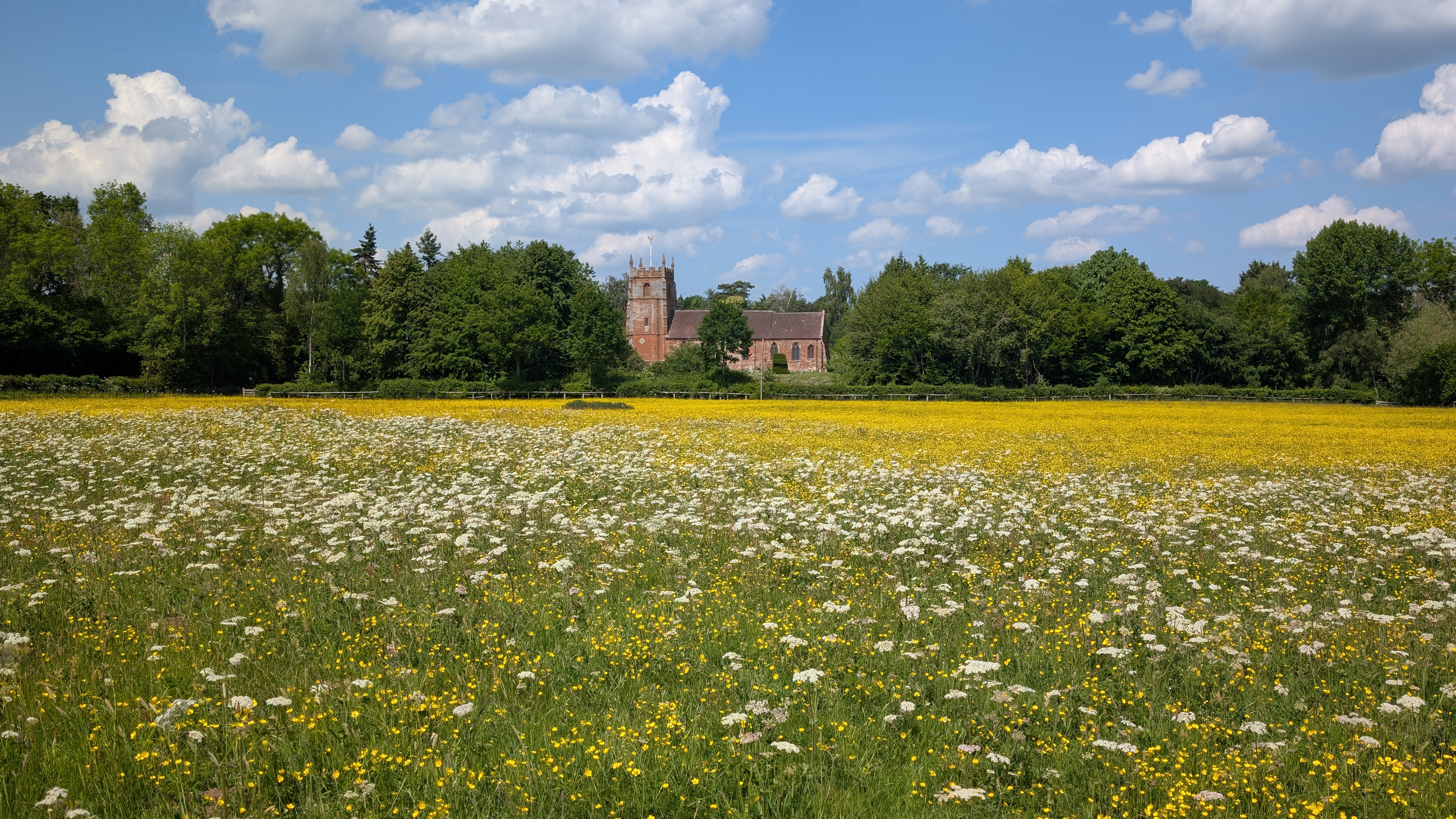
    South St. Peter’s Churchyard, laden with Ox-eye Daisy Leucanthemum vulgare. 20.05.25

    At the Millennium Green, there is a tall, busy grassland which is a cacophony of crickets on a warm June day. In the centre, there is a linear wetland that supports species that like their feet wet, such as Flag Iris Iris pseudacorus, Lesser Pond-sedge Carex acutiformis and Bullrush Typha latifolia and Great Willowherb Epilobium hirsutum.

    Flag iris, bullrush, great willowherb, and nettle swamp. Millenium Green, 20.05.25.

    The grassland surrounding the pond is dominated by False oat-grass Arrhenatherum elatius with spatterings of Hogweed Heracleum sphondylium and Meadow Crane’s-bill Geranium pratense (for the ecologist; MG1 in NVC, g3c5 in UKHab).

    Around the fringes of the green are beautiful perry pear trees (don’t ask me what variety), which were in full blossom by early April. I foolishly took a pear in the autumn, and bit into it, it dried my mouth out like cotton wool – you win some, you lose some.

    That concludes the descriptions of the different areas along the walk, the route and a full list of flowers seen is provided below. Let me know if you see any of these next spring!

    List of Flowers by Month

    These species are listed by the month that I first recorded them flowering on the walk; this is just a rough guide, and these flowers can be found outside of these months too.

    • Barren Strawberry Potentilla sterilis Occasional on shady steep verge and in churchyard
    • Colt’s-foot Tussilago farfara Rare along lane
    • Common Field-speedwell Veronica persica Occasional in churchyard
    • Daffodil Narsiccus sp. Introduced, verge near Hopehouse Farm
    • Dandelion Taraxacum agg. Occasional along lane.
    • Dog’s Mercury Mercurialis perennis Frequent along the length of lane
    • Dwarf Elder Sambucus ebulus
    • Early Dog-violet Viola reichenbachiana in gravel to RHS behind church
    • Grey Field-speedwell Veronica polita Locally frequent on gravelly ramp entering churchyard
    • Ground-ivy Glechoma hederacea Occasional along lane
    • Groundsel Senecio vulgaris Churchyard and disturbed soil on lane (arable).
    • Lesser Celandine Ficaria verna Locally frequent along Hopehouse Lane toward Hollins Lane
    • Primrose Primula vulgaris Locally abundant on verges and in churchyard
    • Red Dead-nettle Lamium purpureum Occasional along lane
    • Smooth Hawk’s-beard Crepis capillaris* Near church doorway
    • Thale Cress Arabidopsis thaliana Frequent in churchyard, rare on lane
    • Wavy Bitter-cress Cardamine flexuosa Rare on lane, frequent in churchyard
    • Sweet Violet (white form) Viola odorata var. dumetorum Abundant on verge opposite the farm entry
    • Sweet Violet Viola odorata var. odorata In churchyard
    • Annual Meadow-grass Poa annua
    • Black Medick Medicago lupulina couple plants before new arable fence
    • Bulbous Buttercup Ranunculus bulbosus
    • Bush Vetch Vicia sepium Bank w Primula
    • Common Mouse-ear Cerastium fontanum gravel path edges sh fl r
    • Common Sorrel Rumex acetosa
    • Common Vetch Vicia sativa Verge opposite HHF
    • Cow Parsley Anthriscus sylvestris Laneside
    • Cow Parsley Anthriscus sylvestris Abundant along lane
    • Cowslip Primula veris On bank lane
    • Creeping Buttercup Ranunculus repens
    • Cuckooflower Cardamine pratensis Occ. Sharp fl rush pasture
    • False Oxlip Primula x polyantha Laneside, grassy bank w P. veris
    • Field Forget-me-not Myosotis arvensis churchyard
    • Field Horsetail Equisetum arvense corner of road and path to church
    • Field Pepperwort Lepidium campestre churchyard
    • Field Wood-rush Luzula campestris Churchyard
    • Garlic Mustard Alliaria petiolata Lane
    • Germander Speedwell Veronica chamaedrys Verge opp & churchyard
    • Greater Celandine Chelidonium majus Churchyard, foot of sandstone wall on trackway
    • Greater Stitchwort Stellaria holostea Locally frequent on hedgerow
    • Green Alkanet Pentaglottis sempervirens Churchyard, foot of sandstone wall on trackway
    • Hawthorn Crataegus monogyna
    • Hogweed Heracleum sphondylium Frequent along lane
    • Meadow Buttercup Ranunculus acris all Rs on corner of Lane and church path
    • Meadow Foxtail Alopecurus pratensis Lane verge
    • Oxalis Oxalis sp
    • pears Pyrus m green
    • Pellitory-of-the-wall Parietaria judaica churchyard
    • Pendulous Sedge Carex pendula verge opp
    • Red Clover Trifolium pratense churchyard
    • Ribwort Plantain Plantago lanceolata
    • Scarlet Pimpenel Lysimachia arvensis churchyard
    • Sweet Vernal-grass Anthoxanthum odoratum bank out front. locally abundant.
    • Thyme-leaved Speedwell Veronica serpyllifolia Verge opp
    • White Dead-nettle Lamium album Laneside
    • Wild Cherry Prunus avium millennium green
    • Autumn Hawkbit Scorzoneroides autumnalis churchyard
    • Barren Brome Anisantha sterilis Millenium Green
    • Bittersweet Solanum dulcamara p Millenium Green
    • Black Bryony Tamus communis lane
    • Daisy Bellis perennis Frequent in churchyard, and verge opposite farm entry
    • False Oat-grass Arrhenatherum elatius Millenium Green
    • Field Bindweed Convolvulus arvensis
    • Hogweed Heracleum sphondylium Millenium Green , lane
    • Lesser Pond-sedge Carex acutiformis pond, Millenium Green
    • Lesser Trefoil Trifolium dubium churchyard
    • Meadow Crane’s-bill Geranium pratense Millenium Green
    • Meadow Vetchling Lathyrus pratensis lane
    • Meadowsweet Filipendula ulmaria lane
    • Pineappleweed Matricaria discoidea arable gate
    • Ragged Robin Silene flos-cuculi pool millennium green
    • Rough Hawkbit Leontodon hispidus churchyard
    • Smooth Sow-thistle Sonchus oleraceus lane
    • Spindle Euonymus europaeus
    • Tufted Vetch Vicia cracca lane?
    • Wild Radish Raphanus raphanistrum arable gate
    • Yarrow Achillea millefolium Millenium Green
    • Yellow Iris Iris pseudacorus Millenium Green
    • Yellow-rattle Rhinanthus minor Millenium Green

    And with that, my total count was 79. And that’s just the beginning; there are dozens more that I didn’t record, as I was only focusing on flowers this time. Let me know if you see any of these plants this spring!

    Tom Ward, 2025
  • Botanical Notes: March 2025

    Botanical Notes: March 2025

    The countryside is waking up, the lanes and woods are decorated with lesser celandine, wood anemones, violets, dog’s mercury and primroses.

    For most of March I have been racing to get out before the sun goes down at around 6:30. But now that the clocks have changed, every evening presents an opportunity to get out exploring and botanising. It is worth noting, that we have had very little rain this month, and that we could really do with a wet April to bring us back in order.

    Talking of which, I am eager to discover what April has in store… But before that, here are some plants that have brightened my March, along with some of my favourite finds this month.

    Favorite Finds

    • Grey field-speedwell Veronica polita at St. Peter’s Church in Martley, where it grew with common field-speedwell V. persica.
    • Rough horsetail Equisetum hyemale, which we found with the NWFG at Chaddesley Woods.
    • Shepherd’s cress Teesdalia nudicaulis, which is having a bumper year on Hartlebury Common.
    • Toothwort Lathraea squamaria and Yellow star-of-Bethlehem Gagea lutea which Cesca Beamish and I relocated from an old record, growing along the Corn Brook.
    • Field mouse-ear Cerastium arvense at Wilden Top Meadow.
    • Hairy whitlowgrass Erophila majuscula, is a nationally scarce plant that grows at the old car park on Hartlebury Common.

    And finally, field pansy Viola arvensis, which just makes me happy when I see it! Here it was growing along Leapgate Lane on a sandy verge.

    Annotated Photos

    Below are photos of each notable species seen this month, including location and date.

    Potentilla sterilis. Grassy bank of St. Peter’s Church, Astley. 03.03.25
    Erophila majuscula. Hartlebury Common. hairs on pedicel. 04.03.25
    Daphne laureola, Penny Hill. 07.03.25.
    Primula vulgaris, Penny Hill. 07.03.25.
    Tussilago farfara, Hopehouse Lane, Martley. 07.03.25.
    Lamium hybridum. Rectory Lane, Areley Kings. 09.03.25.

    Whilst in the office I’ve been walking down Hopehouse Lane to St. Peter’s Church in Martley and photographed a series of plants along the way:

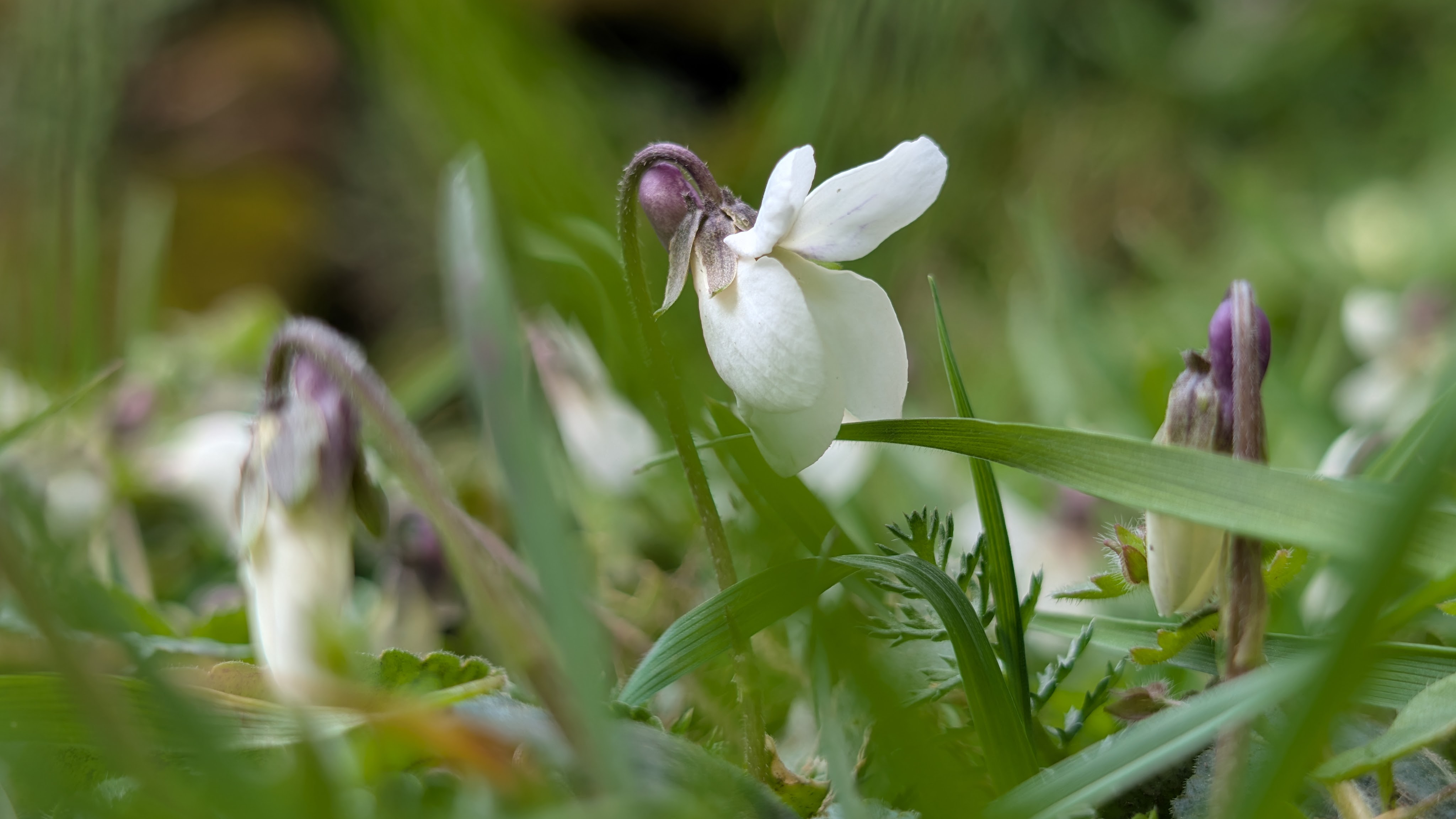
    Viola odorata var dumetorum. St. Peter’s Church, Martley. Locally frequent. 12.03.25.
    Myosotis sylvatica. St. Peter’s Church, Martley. 12.03.25.
    Ficaria verna. Hopehouse Lane. 12.03.25
    Mercurialis perennis (male plants). Hopehouse Lane, Martley. 12.03.25.
    Viola odorata. St. Peter’s Church, Martley. 12.03.25.
    Glechoma hederacea. Mitton Marsh, Stourport-on-Severn. 14.03.25.
    White Deadnettle Lamium album. Mill Road, Stourport-on-Severn. 14.03.25.
    Viola odorata. Charlton Mill, Hartlebury. 15.03.25.
    First flowers of Caltha palustris. Hillditch Pools. 15.03.25.
    Anemone nemorosa. Knapp & Papermill. 16.03.25.
    Luzula. Knapp & Papermill. 16.03.25.
    Veronica persica. St. Peter’s Church, Martley. 19.03.25.
    Veronica persica fruits. St. Peter’s Church, Martley. 19.03.25.
    Veronica polita. St. Peter’s Church, Martley. 19.03.25.
    Veronica polita fruits. St. Peter’s Church, Martley. 19.03.25.
    Rough horsetail Equisetum hyemale Chaddesley Woods NNR. 22.03.25.
    Shepherd’s cress Teesdalia nudicaulis. Hartlebury Common, sandy pipeline. 23.03.25.
    Viola odorata red form. Tontine, Stourport-on-Severn. 24.03.25.
    Gagea lutea on the Corn Brook. 29.03.25.
    Comparison between Hyacinthoides non-scripta and Gagea lutea leaf tips. 29.03.25.
    Toothwort Lathraea squamaria. Corn Brook. 29.03.25.
    Myosotis discolor. Stourport Manor Hotel. 30.03.25.
    Cerastium arvense. Wilden Top Meadow. 30.03.25.
    Viola arvensis. Leapgate Lane. 30.03.25

  • Field Mouse-ear (Cerastium arvense) at Wilden Top Meadow

    Field Mouse-ear (Cerastium arvense) at Wilden Top Meadow

    30.03.25. Wilden Top Meadow. “Three large clumps growing on anthills, Grassland fairly rank so possibility of becoming swamped out. Patches c. 50cm x 50cm. Plenty of flowers SO82857243” “Another small patch c. 20cm x 20cm at SO82797242 with Rumex acetosa”

    Cerastium arvense at Wilden Top Meadow. 30.03.25. SO82857243

    I can’t recall ever seeing this plan in Worcestershire. The only record I have of this species on iNaturalist is from a work site in Catterick, North Yorkshire, dated July 2023.

    While cycling on Sunday afternoon, I decided to visit a rough grassland area known as Wilden Top Meadow, where C. arvense had been previously recorded by W.A. Thompson in 1993 and most recently by C. Beamish in 2024.

    I was pleased to find three clumps of the plant thriving on a series of anthills in what is otherwise quite overgrown grassland, which is reportedly owned by Wilden Industrial Estate. There were two distinct populations: one near the entrance at SO82857243 and another further into the site near the broom scrub at approximately SO82797242.

    I believe the plant’s survival can be attributed to localised disturbance occurring on the anthills and pathways used by local residents, as most of the population was found on hummocks adjacent to the main path running through the site and I didn’t find any more in the wider grassland.

    What does the future look like for this diminutive, relatively scarce county plant, if the site continues to be ungrazed and the bracken marches ever further forwards?

  • Rough Horsetail (Equisetum hyemale) at Chaddesley Woods

    Rough Horsetail (Equisetum hyemale) at Chaddesley Woods

    Rough Horsetail Equisetum hyemale, near pool at Chaddesley Woods NNR

    On Saturday (22.03.2025) we held a North Worcestershire Flora Group meeting at Chaddesley Woods NNR. We had set out to record along the main rides, but also to search for two rarities: Marsh violet Viola palustris and Rough Horsetail Equisetum hyemale.

    We failed to refind the marsh violet after a fruitless 30 minutes searching the ditch where it was last recorded as ‘a few plants’ in 2010 by R. Maskew.

    Although, there was a lot of leaf litter, and a large fallen tree which may have been covering them, it was also fairly early in the year. It was noted that there were no Sphagnum moss which would normally be expected associates.

    Following this we walked to the pool located at SO 91053 73648 and began our search for Rough Horsetail Equisetum hymale. With only 44 all time records of this species in the county, and only known from two tetrads post-1987, it’s one of our rarer species. It was originally found at this location by previous county recorder Fred Fincher during 1978.

    We stood a good chance of re-finding this record, as it was a known population most recently seen in 2016 by R. Maskew, where there were ‘400 stems, poolside’.

    After a lap of the pond and Typha swamp, we eventually spotted a few stems protruding from the bank.

    Upon close inspection it was a large patch, in a marshy area adjacent to the Typha beds, on the western bank of the pool. It was mostly abundant along the bank top and reached approximately 2m from the waters edge for a 5m length. It was located the edge of the original concrete dam wall, as mentioned in previous records.

    There were hundreds of stems still, as per 2016 and associated species included Carex pendula, Arum maculatum, Mercurialis perennis and Urtica dioica.

    Overall a successful day, but I’d still love to see Viola palustris in VC37. One for a future search…

  • 10 Places within 10 Minutes of Stourport-on-Severn

    10 Places within 10 Minutes of Stourport-on-Severn

    1. The List
      1. ‘Doorstep’ Places
        1. Mitton Marsh Conservation Area
        2. Hartlebury Common Nature Reserve
        3. Hillditch Pools & Coppice
        4. Leapgate Railway Line Country Park
        5. Ruins of the Church of St. Michael
        6. Staffordshire & Worcestershire Canal & Basins
        7. Lincomb Lock, River Severn
      2. ‘Drive to’ Places
        1. Wilden Marsh Nature Reserve (WWT)
        2. Burlish Meadows Conservation Area
        3. Burlish Top Local Nature Reserve
    2. Background & Motivations
      1. Criteria for Inclusion
      2. Additional Reading

    The List

    ‘Doorstep’ Places

    Mitton Marsh Conservation Area

    This is a short loop that can be done on foot in around 30 minutes literally from the front doorstep. Follow the footpath that can be picked up from the junction of Millfields Drive and the B4193 which runs along the bank of the River Stour.

    The interior of the marsh is a fenced off and is sometimes grazed by cattle, and Hybrid Woundwort Stachys x ambigua is frequent along the riverbank. The footpath exits onto Mill Road. Here, where the Stour passes underneath your feet it feels like you could be in the Peak District, and on a hot day it is a oasis of cool air.


    Hartlebury Common Nature Reserve

    Hartlebury Common feels like a truely wild place and supports some brilliant wildlife. The world is your oyster here, with lots of winding paths amongst the bracken and gorse to get lost in. I like to combine the common with a walk through Hillditch Coppice to Charlton Mill.


    Hillditch Pools & Coppice

    Whilst this is technically part of the Hartlebury Common Nature Reserve complex, it’s worth visiting in its own right as there are pools and a lovely Alder carr woodland that is full of Marsh Marigold Caltha palustris in the spring.


    Leapgate Railway Line Country Park

    The disused branch line of railway line was part of the original Severn Valley Railway and connected Hartlebury to Stourport, which was built around 1862. It is now a brilliant footpath and national cycle route which connects Stourport to Hartlebury passing the viaduct over the River Stour and through deep sandstone cuttings. From the viaduct there are panoramic views over the Wilden Marsh and over to Malvern, where on a clear day you can see the Worcestershire Beacon.

    The railway can be accessed from many spots near Stourport: off Wilden Lane near the Rock Tavern, from the canal near the Bird in Hand and at the northern end of Millfields Drive. This walk can be combined with the Hillditch Coppice loop, back onto Hartlebury Common too.

    Ruins of the Church of St. Michael

    Walk along the towpath of the Staffordshire and Worcestershire canal from Mill Road, past the Bird in Hand pub and cross the Mitton Chapel No.2 bridge into St. Michael’s Churchyard.

    Mitton Chapel No.2 Bridge. 23.10.2024.

    At the western edge of the churchyard is a ruin. There are also some good Geocaches in the churchyard and along the canal towpath which are worth looking for. Combine this walk with a further walk down to the basins.

    Remains of church, begun in 1881 but unfinished when consecrated in 1910. Never subsequently completed, and partially demolished in 1980. By George Gilbert Scott, continued after his death by his son, John Oldrid Scott. Sandstone facing over brick core. What survives is the footings for the west wall, and substantial parts of the north and south walls, including the south porch – Historic England


    Staffordshire & Worcestershire Canal & Basins

    Walk down the canal and follow it underneath the Gilgal into town. Pass the Black Star (a great pub, lovely food and well priced) and cross York Street to get to Mart Lane.

    Here there are houses that are listed ancient monuments, as well as the main Stourport basin on your right. Follow Mart Lane down to the river, passing the basin and the Tontine on the right, here you are rewarded with great views of the Severn.


    Lincomb Lock, River Severn

    See my previous blog post about this walk, it can easily be done from Stourport by walking south along the lower common and crossing the Worcester Road onto Lincomb Lane. Pass through the caravan park and onto the Severn Way and Lincomb Lock is just a few hundred yards south along the footpath.


    ‘Drive to’ Places

    Wilden Marsh Nature Reserve (WWT)

    3 minute drive. Just down Wilden Lane and you can be at Wilden Marsh Nature Reserve, there is a small layby to park in next to the yard. We visited here with the NWFG in 2022, but that was from Marsh Farm. I’d like to revisit from the public entrance. More detail to follow.


    Burlish Meadows Conservation Area

    6 minute drive. This ex-golf course is a botanical treasure trove, with all sorts of oddities turning up due to the disturbance and sandy soils. Parking: https://maps.app.goo.gl/ARqA76ACXJYjpT9i6. More detail to follow.


    Burlish Top Local Nature Reserve

    7 minute drive. Mixed grassland, heathland and woodland habitats. Apparently some of the best lowland acid grassland in the county. There is a small car park further up the Kingsway from Burlish Meadows. This can be linked with a walk to the Rifle Range and Devil’s spittleful.


    Background & Motivations

    I got my first car in 2018, and this was when I really started visiting nature reserves and going on what I deemed ‘adventures’. I was working for myself and seemingly had all the time in the world to carefully plan my forays out of Birmingham to the countryside.

    Now that I’ve lived out here for a while (and don’t have the same urge to escape the city) I’ve noticed that I’m struggling with all of the choices of wonderful places to visit. So, future Tom, here’s a list of ‘Ten Spots within Ten Minutes’ of the front door. Make the most of those spare hours and golden afternoons.

    My Skoda Felicia pickup truck parked at Deans Green, Warwickshire. 07.08.18.

    Criteria for Inclusion

    • Travel time to the place must be 10 minutes or less from The Grove, Stourport-on-Severn.
    • The place must have natural history or local historical interest.

    Additional Reading

    For more inspiration on places to go have a look at:

    • The Worcestershire County Council website.
    • There is a list of Wyre Forest District reserves here.
    • Revisit local Geocaches!

  • Botanical Notes: August & September 2024

    Botanical Notes: August & September 2024

    It’s been a while! But we’re back with some botanical highlights from August and September, and my first couple of months with Severn Rivers Trust.

    1. Hybrid Woundwort (Stachys x ambigua). It shares the characters of both parents (S. sylvatica and S. palustris), but unlike S. palustris it has leaf stalks! These plants were growing at Mitton Marsh, along the floodplain of the River Stour. 06.08.24.

    2. Lilac form of Scarlet Pimpernel (Lysimachia arvensis f. lilacina) at Penny Hill disused quarry, whilst looking at Rosa with Roger M. I’m still not convinced on the taxonomy of this plant, as on iNaturalist I’ve had a comment saying that it is Lysimachia arvensis × loeflingii 22.08.24.

    3. Marsh Ragwort (Jacobaea aquatica) from some nice rush-pasture on a site in Shropshire. It was growing in a wet transitional zone between MG10 Holcus-Juncus and M23 Juncus acutiflorus-Galium palustre rush-pasture NVC communities. I later also found a bit more of it in pure M23. The features that drew my eye to this plant were the well spaced capitula and blunt stem-leaves. 02.09.24.

    4. Sneezewort (Achillea ptarmica) found at the same site as J. aquatica in marshy grassland / rush pasture. Shropshire. 19.09.24.

    5. Corn Spurrey (Spergula arvensis) growing in abundance in farm gateway, Shropshire. GB & Eng Redlisted as Vulnerable. Site as above, but in the gateways and disturbed areas of the fields with the MG6 Lolium-Cynosurus NVC community. 19.09.24.

    6. Common Calamint (Clinopodium adscendens) along an arable field margin / bank in Bredon, Worcestershire. This was found this along the same arable field margin that we took the NWFG to in July. I was on Bredon Hill again for work and happened across Adrian of Kemerton, who kindly pointed the Calamint out. 04.09.24. Note that the flower-clusters are not dense whorls but instead are cymes with a common stalk, the flower colour is also different. See C. acinos photo below for comparison.

    Dense axillary whorls of Wild Basil Clinopodium vulgare. Bredon Hill, July 20th 2024.

    #botany #ukbotany #worcestershire #shropshire

  • Lesser Chickweed (Stellaria pallida): Hartlebury Common 19.02.24

    Stellaria pallida Lesser Chickweed – 19.02.24

    Whilst rummaging in the short turf of Hartlebury Common I spotted this diminutive member of the Campion family Caryophyllaceae.

    It is odd amongst Stellaria in that it often has no (or only minute) petals, which is quite a distinctive feature.

    -It also has just 1 to 3 stamen, which splits it off from a depauperate Common Chickweed Stellaria media which can have 3 to 8 stamen.

    Genera Tips

    Stellaria (3) is split off from similar genera within the family such as Myosoton (5) and Cerastium (5) by the number of styles.


  • Recording: Ribbesford Woods [SO7872] Staffordshire & Worcestershire Canal, Stourport [SO8171]

    Recording: Ribbesford Woods [SO7872] Staffordshire & Worcestershire Canal, Stourport [SO8171]

    It’s November, I’ve finally got some time on my hands after what turned out to be a busy field season. I’m back in my home county of Worcestershire and I’ve decided to carry on doing some local monad bashing. I don’t think there’s a better way to improve your botanical ID skills than trying to record everything in a 1km x 1km OS Grid square (monad).

    Ribbesford Woods – Wyre Forest, Worcestershire (08.11.21)

    Ribbesford – SO7872 – 101 spp.

    I’ve been meaning to visit Ribbesford since I moved to Stourport last year but never got round to it cause the parking seemed awkward and it was a popular spot due to mountain-biking, it’s no longer a bike park so a bit quiter so I gave it a go and managed to record over 100 species of plant (101 to be exact), this was including some bryophytes, but I’m pretty hyped that I managed to get a 100+ monad working alone….in November!

    The highlight for me was finding this tiny scroph-like annual called Kickxia elatine (Sharp-leaved Fluellen):

    Stourport SO8171 – 70 spp.

    Ruined Church of St Michael, Stourport-on-Severn, Worcestershire

    A quick walk down the canal from my house, to the local Mitton Chapel cemetery revealed some 70 species of plants, including two comfrey species: Symphytym x uplandicum (Russian Comfrey) and S. officinale (Common Comfrey). I’d like to walk further in this monad, as it goes right down to Stourport basin so I reckon it’d quite species rich.

    I used the key in Stace to tell them apart, but what was very notable were the winged stems made up of decurrent leaves on S. officinale in comparison to S. x uplandicum. Upon close inspection the calyces were completely different too, both in shape and in pubescence.

    Summary

    So what does this tell us? What can we take away from this? That monad bashing makes you key out more, and teaches you new species that you’d take for granted otherwise. I walk this canal multiple times a month and know there’s comfrey down it, I had always assumed they were the same species, but they’re not.

  • SO7477: Longdon Orchard, Wyre Forest

    SO7477: Longdon Orchard, Wyre Forest

    12.01.21 – Winter vegetation survey that found 47 plant taxa (1:30hrs)

    Would like to go back when there’s less snow and ID some of the plantation conifers to species as well as checking all the Ulex to see how many species are present. Be nice to have a better go at the grasses and mosses too.

    There’s a nice bit of natural woodland where the “123” is on the OS map below. At the time I thought it resembled W16 (Quercus – Betula – Deschampsia) but it’d be nice to go again and confirm, see a photo below.

    (more…)